Tag: <span>pelvic floor dysfunction.</span>

Pelvic Pain Explained: Vulvodynia + Resource List

In Female Pelvic Pain by Emily Tran / May 9, 2019

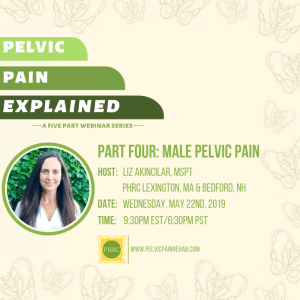
May is Pelvic Pain Awareness Month At PHRC we want to do our part to help people better understand pelvic pain syndromes and more importantly, help people suffering with these diagnoses get the help they need to recover. Since knowledge is power, we created 5 videos and blog posts that we hope people find useful. […]

Book Review: Why Pelvic Pain Hurts

In Pelvic Floor Physical Therapy by Emily Tran / February 28, 2019

By: Rachel Daof, DPT “Imagine the following: You feel a sudden new, surprising and sharp pain in your thumb while you’re at the office. You look at it and inspect the thumb. You touch it and feel around to see if there is anything out of the ordinary. You move it around. You discuss it […]

EVERYTHING Is Connected: What is Visceral Manipulation and How Does it Relate to the Pelvic Floor?

In Pelvic Floor Physical Therapy by Emily Tran / November 21, 2018

Remember our earlier post on fascia? Simply put, fascia is a continuous sheath of connective tissues that lines everything in our body – the organs, bones, muscles, blood vessels, nerves etc. Healthy fascia is fluid and mobile. It allows everything in the body to slide and glide promoting healthy and balanced movement. Restrictions in fascia […]

Managing Life on or after “The Pill”

In Female Pelvic Pain by Jandra Mueller / October 18, 2018

By: Jandra Mueller, DPT, MS, PHRC Encinitas If you are a female reader of our blog, have experienced painful intercourse, and happened to have come to the Pelvic Health and Rehabilitation Center (PHRC) for treatment, then you are probably familiar with our talk about how systemic birth control like oral contraceptives (OCPs) or “The Pill,” […]

Part 1 of 2: What is a good pelvic PT session like?

In Pelvic Floor Physical Therapy by Emily Tran / September 27, 2018

Pelvic Health and Rehabilitation Center is proud to announce that we now have eight locations across the country. Our newest locations include Walnut Creek, CA, Bedford, NH and Westlake Village, CA. We pride ourselves on our constant commitment to give the best possible care for our patients. Patients suffering from long-standing pelvic conditions are often […]

Wait there’s a (secret) society for that?

In Pelvic Floor Physical Therapy by Emily Tran / September 20, 2018

In the age of social media and WebMD, often times I will have a patient who has gained information from all sorts of sources all over the internet. It takes a lot of effort to weed through the information that the patient has “learned” and separate fact from fiction. One of the best and most […]

How Pelvic Floor Physical and Occupational Therapy Can Serve the Transgender Population: Part 1

In Transgender Pelvic Health by Elizabeth Akincilar / August 22, 2018

By: Shannon Pacella Earlier this summer, Dr. Heidi Wittenberg wrote a blog post enabling medical providers to understand transgender healthcare needs, which you can read here. Following Dr. Wittenberg’s lead, I was fortunate enough to attend an educational course focused on the physical and occupational therapy evaluation and treatment of transgender patients, and I believe […]

Fistula: The other F Word

In Pelvic Floor Physical Therapy by Kim Buonomo / August 16, 2018

Image by: erpete By: Kim Buonomo When I was asked to write a blog article, I wasn’t sure what topic I should write about. I read a lot of our previous articles for inspiration and realized a couple things: 1) The women who work here really know their stuff about the pelvic floor; and 2) […]

Mindfulness Meditation: Is it actually effective for treating chronic pain?

In Pelvic Floor Physical Therapy by Stephanie Prendergast / August 9, 2018

By Elizabeth Akincilar Mindfulness meditation. Even if you’re not exactly sure what it is, I’m going to bet you’ve heard of it. It has gotten a lot of attention recently. It’s everywhere. It’s not like the mediation of 20 years ago. Back then meditation was considered “alternative” or  “fringe” that few people practiced, especially in […]

Skip to content