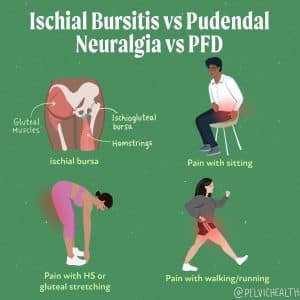
By Lauren Opatrny, PT, DPT, PHRC San Francisco, CA Ischial bursitis, or ischiogluteal bursitis, is a condition where the bursa that lies between the ischial tuberosity and the gluteus maximus muscle becomes inflamed.(1) Ischial tuberosities are the bones that we sit on and are commonly referred to as your “sits bones.” They provide support for the body while sitting …
Scar Facts: All You Need to Know
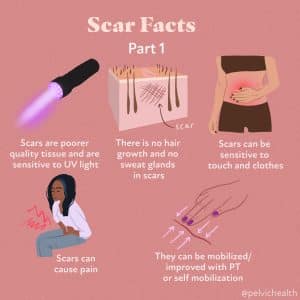
By Stephanie Prendergast, MPT, Cofounder, PHRC Los Angeles Let’s talk scars and facts: Scar tissue is of poorer quality than regular tissue; therefore it is more sensitive to UV light. Be sure to protect your scars with SPF! Don’t be surprised when hair doesn’t grow back in your scars. Hair follicles and sweat glands do not regenerate in …
What is Persistent Genital Arousal Disorder (PGAD/GPD)? Part 2
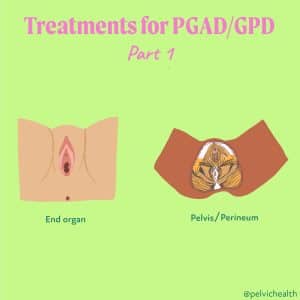
By Stephanie Prendergast, MPT, Cofounder, PHRC Los Angeles In 2021, a panel of experts published a consensus and management of care paper on Persistent Genital Arousal Disorder/Genito-Pelvic Dysesthesia (PGAD/GPD) in the Journal of Sexual Medicine. The paper describes a treatment algorithm involving five different therapeutic targets for PGAD/PGD! The paper describes how clinicians newer to treating this diagnosis can …
Sleep Hygiene: The Do’s and Don’ts to Maximize Your Rest
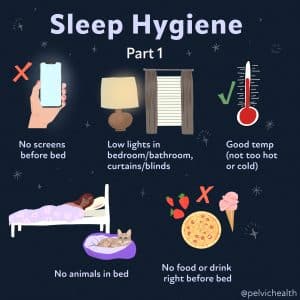
By Stephanie A. Prendergast, MPT, Cofounder, PHRC Los Angeles Getting enough restful sleep is paramount for a healthy body. The benefits are too many to name here. It can be a challenge to get a good night’s rest for many people. Here are some basic tips to improve the quality of your sleep! Stay away from screens before …
Ilioinguinal Neuralgia: Causes and Treatment
By Stephanie A. Prendergast, MPT, Cofounder, PHRC Los Angeles Ilioinguinal neuralgia is typically caused by a surgical procedure or an inguinal hernia. A hernia is when tissue pooches through the abdominal wall due to a weak point in the abdomen. An inguinal hernia, which is a hernia in the inguinal canal, can put pressure on the ilioinguinal nerve, …
2023: Year of the Rabbit, A (2022) Year in Review
By Stephanie A. Prendergast, MPT, Cofounder, PHRC Los Angeles Welcome 2023, goodbye 2022! It’s been another year full of changes for Pelvic Health and Rehabilitation Center. With the start of the new year, we would like to acknowledge all of the changes that have occurred both virtually and in person. Last year….. PHRC Pasadena opened in January 2022, …
Prostatectomy: Facts, Complications and How Pelvic Floor PT Can Help
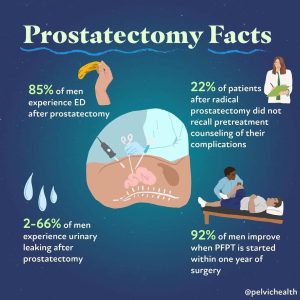
By Stephanie A. Prendergast, MPT, Cofounder, PHRC Los Angeles Let’s Talk Prostatectomy Facts Although prostatectomy is a very effective surgical intervention for prostate cancer, there are some common symptoms that can occur following surgery that each person undergoing this procedure should be aware of. In fact, only 22% of patients undergoing radical prostatectomy were sufficiently counseled on the …
Clitoral Pain: Causes and Treatment
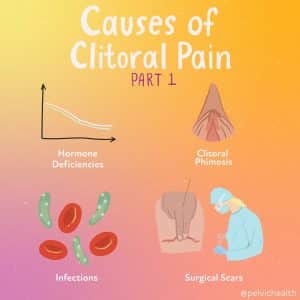
By Stephanie A. Prendergast, MPT, Cofounder, PHRC Los Angeles There are a number of treatable causes of clitoral pain, yet often patients are misdiagnosed and this distressing symptom can persist. Hormonal deficiencies associated with birth control pills, acne medications, and age can lead to thinning of hormonally sensitive structures, such as the clitoris and clitoral hood. This can lead …
Pelvic Pain 101: Definition + Resource List
By Stephanie A. Prendergast, MPT, Cofounder, PHRC Los Angeles “Can you please define to us what exactly is pelvic pain when sitting. Over the bladder? In the groin? On the labia? Rectum? Sit bone? Like period cramps? What is the most common definition? I’d love for this to be a post or a question for all. I keep wondering …
PHRC is going back to Nairobi, Kenya!
By Elizabeth Akincilar, MPT, Cofounder, PHRC Merrimack PHRC is going back to Nairobi, Kenya! The Pelvic Health and Rehabilitation Center is returning to Nairobi, Kenya to teach a pelvic health course to a second cohort of physical and occupational therapistss in October 2022. We taught the first cohort of physical and occupational therapistss in February 2020 and unfortunately …
IPPS Post-Conference Specialty Course
By Amy Stein, MPT, DPT, BCB-PFD, IF & Karen Brandon, DSc, PT, WCS This year we are excited to present a post-conference course dedicated to physical and occupational therapy clinical skills and treatment planning for complex endometriosis cases. This workshop is in-person and virtual. We are so excited to have an all-star group of presenters, an expert panel, and case dissection round …
Pudendal Neuralgia Frequently Asked Questions- Answered
By Elizabeth Akincilar, MPT, Cofounder, PHRC Merrimack Over the last couple of years PHRC has shared many YouTube videos and educational material on Instagram educating our viewers and readers about pelvic health. We have received an overwhelming response to several of our posts discussing pudendal neuralgia. Listed below are some of the most common questions we’ve received and our answers. …
How Alexandra Recovered from Pudendal Neuralgia at PHRC
By Stephanie A. Prendergast, MPT, Cofounder, PHRC Los Angeles Why do my sitz bones hurt with sitting, but not when sitting on the toilet? Alexandria’s Success Story with Highs and Lows throughout the Healing Process The History of Alexandria’s Pain and How She Found PHRC Alexandria is a 62-year-old female who showed up to PHRC with eight out …
Pain in your tailbone? You are not alone: Michelle’s Success Story
By Jennifer Keesee, PT, DPT, PHRC Westlake Village Michelle is a 39 year old patient who was referred to PHRC by her pain management specialist for evaluation and treatment of tailbone pain, known as Coccydynia. Her symptoms started one year after giving birth to her second child, and had continued off and on for about three years. Michelle did …
Myofascial Trigger Points: Facts & General Information
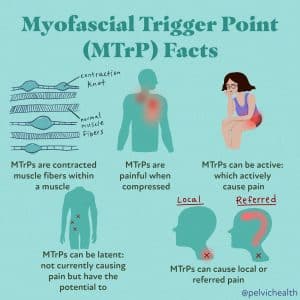
By Stephanie A. Prendergast, MPT, Cofounder, PHRC Los Angeles Let’s talk Myofascial Trigger Point (MTrPs) Facts: MTrPs are contracted fibers with a muscle. MTrPs are painful when compressed. Active MTrPs cause pain and/or dysfunction whereas latent MTrPs do not currently cause pain and/or dysfunction but have the potential to. MTrPs can cause pain locally (at the spot of the …
Myofascial Trigger Points – Frequently Asked Questions & Their Answers
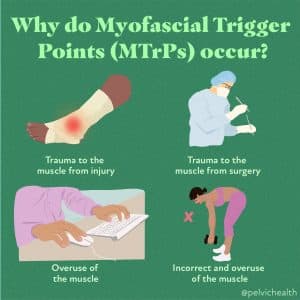
By Stephanie A. Prendergast, MPT, Cofounder, PHRC Los Angeles Over the last few week’s, we have received various inquiries about Myofascial Trigger Points. Why do they occur? What are they? How can we fix them? This week we do a deep dive and answer our most frequently asked questions! Q: Never heard of this ! What is this …
Hard Flaccid: Causes, Treatments, and Symptoms
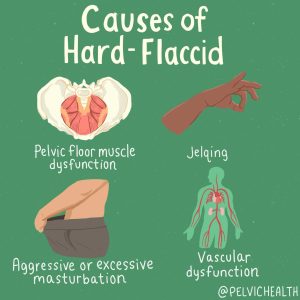
By Elizabeth Akincilar, MPT, Cofounder, PHRC Merrimack Although our knowledge is limited with regards to hard-flaccid syndrome, based upon the minimal medical literature dedicated to this syndrome and our own experience at PHRC, hard-flaccid syndrome most commonly occurs secondary to the following: When the PFM, particularly the urogenital diaphragm, or superficial PFM, become too tight or hypertonic, they can …
Success Story: How PFPT Helped Following Peter’s Prostatectomy
By Melinda Fontaine, DPT, PHRC Walnut Creek Peter was a 63 year old experiencing urinary urgency and leakage three months after having his prostate surgically removed for prostate cancer. Luckily, his surgeon referred him to a pelvic floor physical and occupational therapists. He was using at least two incontinence pads per day, but was mostly dry at night. He had …
Penile Pain: Frequently Asked Questions and Their Answers
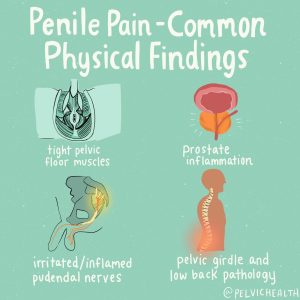
By Elizabeth Akincilar, MPT, Cofounder, PHRC Merrimack Over the last couple of years PHRC has shared many YouTube videos and educational material on Instagram educating our viewers and readers about pelvic health. We have received an overwhelming response to several of our posts discussing male pelvic pain, in particular penile pain. Listed below are some of the most common …
Busting Menopause Myths: How the Women’s Health Initiative Changed Women’s Health Overnight
By Stephanie A. Prendergast, MPT, , Cofounder, PHRC Los Angeles It is common knowledge amongst medical professionals and researchers that it takes an average of 17 years for research evidence to reach clinical practice. In 2002 an event occurred that changed healthcare overnight for menopausal women, affecting over 50 million people at the time. Twenty years later, tremendous confusion …
Postpartum Urinary Incontinence is Common: Here’s How We Can Help
By Lauren Opatrny, PT, DPT, PHRC Berkeley & San Francisco *all names have been changed to maintain patient privacy Background Rachel* is a 32 year old experiencing urinary incontinence after giving birth to her baby in December 2020. When she was eight months postpartum and still experiencing incontinence, her doctor referred her to pelvic physical and occupational therapy. …