
By Stephanie Prendergast, MPT, PHRC Pasadena
Many people think of Restless Leg Syndrome (RLS) as a sleep-related leg problem ; the irresistible need to move, the creeping sensations, the nights spent pacing instead of resting. But growing research and clinical observation suggest something much broader: RLS may be part of a whole-body sensory and motor dysregulation, with ties to bladder symptoms and pelvic floor dysfunction, including a number of pelvic pain syndromes.
At the Pelvic Health and Rehabilitation Center (PHRC), we’ve seen this overlap firsthand. Patients with persistent pelvic tension or ‘tightness’, urinary urgency and/or frequency, irritative bladder symptoms, or genital discomfort sometimes describe “restless” sensations not just in their legs, but deep in their pelvic structures. Understanding these links helps us design more comprehensive treatment plans that address both the pelvic floor and the nervous system that governs it.
Understanding Restless Leg Syndrome in Context
As outlined in our previous post, RLS is a neurological condition characterized by an urge to move the legs, especially at night or during rest. It’s thought to arise from dopaminergic dysregulation and iron deficiency in the brain, both of which disrupt smooth motor control and sensory processing.
Beyond the legs, the condition reflects a sensory hypersensitivity ; the nervous system becomes overly reactive to otherwise normal sensations. This helps explain why some individuals also experience “restless” or uncomfortable sensations in other regions, including the pelvic and genital area.
Restless Genital Syndrome: A Clue from the Pelvis
A condition called Restless Genital Syndrome (RGS), first described in the early 2000s, presents with sensations of tingling, pressure, or internal agitation in the genital or pelvic region. Importantly, these sensations are not linked to sexual arousal and often worsen at rest, just like RLS.
Neurophysiological studies have shown that some people with RGS also meet criteria for RLS, and both conditions often respond to dopaminergic medications (like pramipexole). This overlap suggests they share a common mechanism ; likely involving the lumbosacral nerves that control both the legs and the pelvic floor.
At PHRC, we think of RGS as part of a continuum of sensory-motor dysregulation. The same central nervous system patterns that drive restless legs ; dopamine imbalance, sensory hyperexcitability, and altered movement feedback ; can easily extend into the pelvic region.
Shared Pathways: The Neurology of RLS and the Pelvic Floor
The pelvic floor is more than a group of muscles; it’s a hub of sensory and motor information, richly connected through the sacral spinal cord and the pudendal nerve. These nerves share close connections with the pathways implicated in RLS.
Here’s how the two systems intersect:
- Shared nerve roots: The lower spinal cord (L2–S3) sends fibers to both the legs and pelvic organs. When these circuits become dysregulated, sensory symptoms may appear in either or both regions.
- Autonomic involvement: RLS is linked to changes in autonomic nervous system activity (fight-or-flight vs. rest-and-digest). Pelvic floor tone is also heavily influenced by autonomic balance ; many people with chronic stress or poor sleep develop hypertonic pelvic floor muscles.
- Neuroinflammation and iron metabolism: Iron deficiency, microglial activation, and dopamine dysregulation seen in RLS may also affect pelvic nerves, influencing pain perception and muscle tone.
- Movement and muscle co-contraction: Just as RLS causes involuntary leg movements, some people experience unconscious pelvic floor tightening during episodes of restlessness or nocturnal movement.
In other words, the restlessness of RLS may extend into the pelvis, resulting in pelvic floor overactivity, urinary urgency, or genital discomfort.
Bladder and Bowel Clues
Several studies have explored the connection between RLS and overactive bladder (OAB). Patients with RLS often report more urinary urgency, frequency, and nocturia (waking to urinate at night). One hypothesis is that both RLS and OAB stem from hyper-responsive sensory circuits in the spinal cord and brainstem.
Similarly, chronic constipation ; common in both pelvic floor dysfunction and RLS ; can worsen sensory feedback loops, leading to further pelvic tension. At PHRC, we see how unaddressed bowel dysfunction perpetuates pelvic and lower limb discomfort.
These observations reinforce the need to look beyond single symptoms. A patient’s nighttime restlessness, urinary urgency, or pelvic pain may all share a nervous-system origin.
The Female Connection
RLS is twice as common in those assigned female at birth, particularly during pregnancy and menopause ; life stages characterized by hormonal shifts that influence both the nervous system and pelvic tissues. Estrogen and progesterone fluctuations can alter dopamine sensitivity, while pregnancy increases venous congestion and iron demands. These same changes can trigger or worsen pelvic floor dysfunction, pelvic pain, or bladder symptoms.
Recognizing these overlapping hormonal and neurovascular influences is critical for accurate diagnosis and individualized care.
How Pelvic Floor Physical and Occupational Therapy Can Help
Even though RLS is a neurological condition, pelvic floor physical and occupational therapy can play a valuable role, especially when pelvic symptoms coexist. Here’s how:
- Muscle down-training and relaxation: Manual therapy, biofeedback, and breathing techniques help calm hypertonic muscles that may tighten reflexively during RLS episodes.
- Nerve mobilization: Gentle neural gliding and positional release techniques support the pudendal and sciatic nerves, improving blood flow and decreasing neural tension.
- Circulatory enhancement: Movement, stretching, and soft tissue work improve lower-body and pelvic circulation, which may reduce discomfort from venous congestion.
- Autonomic regulation: Incorporating mindfulness, diaphragmatic breathing, and body-scan exercises helps reduce sympathetic overactivity ; the same system that amplifies both pelvic tension and RLS restlessness.
- Interdisciplinary care: Collaboration with physicians is essential to address systemic contributors such as iron deficiency, sleep deprivation, or dopaminergic imbalance.
When treatment combines neurologic management and pelvic rehabilitation, patients often notice better sleep, less pelvic tension, and improved quality of life.
Practical Tips for Those With Restless Leg Syndrome and Pelvic Floor Dysfunction
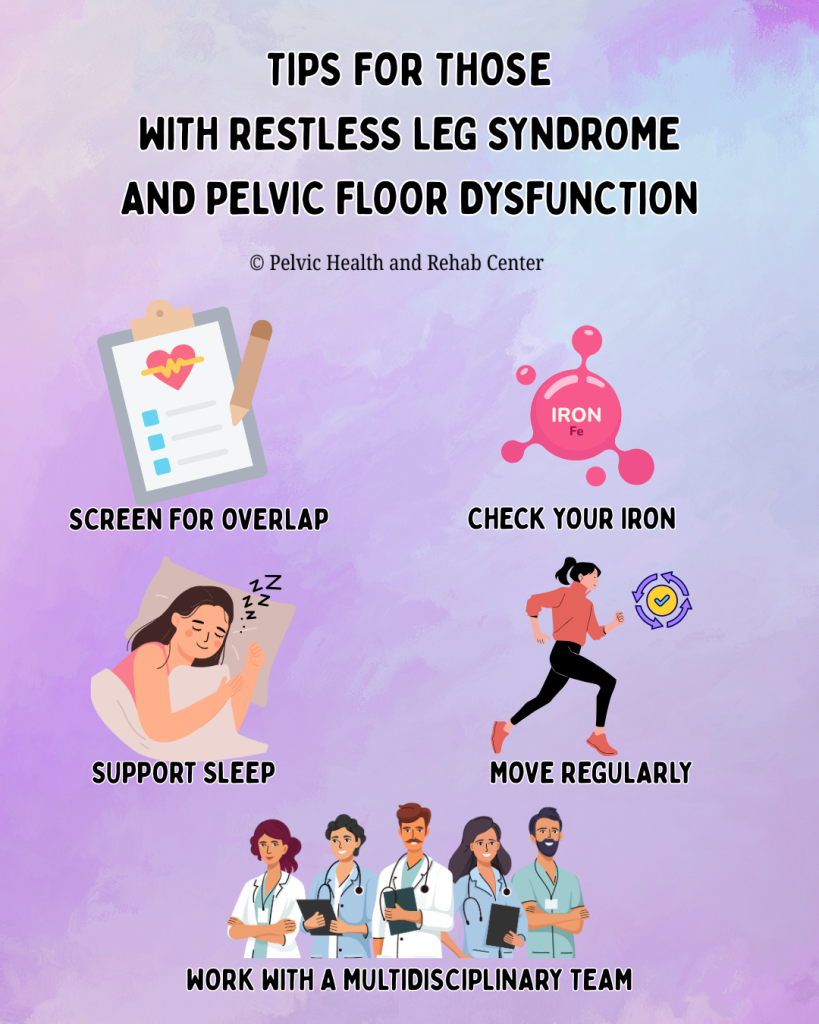
Screen for overlap: If you have pelvic pain or urinary urgency plus nighttime leg restlessness, tell your provider. Both may stem from one nervous-system imbalance.
Check your iron: Ferritin levels below 75 µg/L are linked with RLS; optimizing iron can help both leg and pelvic symptoms.
Move regularly: Gentle evening stretches, walking, or yoga reduce both leg and pelvic tightness.
Support sleep: Consistent bedtime routines, magnesium intake (if appropriate), and stress reduction lower symptom intensity.
Work with a multidisciplinary team: A pelvic health physical therapist, primary care physician, and possibly a neurologist can coordinate a plan that addresses all levels ; muscular, vascular, and neural.
The Takeaway
Restless Leg Syndrome is more than a “leg problem.” It’s a systemic sensory-motor dysregulation that can influence the pelvic floor, bladder, and even sexual function. For some, the pelvis becomes part of the “restlessness loop” ; muscles tighten, nerves fire excessively, and the nervous system can’t find calm.
The good news: once recognized, these connections can be treated. Through integrated care ; neurologic, musculoskeletal, and behavioral ; patients can regain rest, comfort, and control over both their legs and their pelvic health.
At PHRC, we treat the body as an interconnected system. Whether your symptoms start in the legs, pelvis, or both, our goal is to restore balance, reduce tension, and help you feel at home in your body again.
References
Malykhina, A. P. (2007). Neural mechanisms of pelvic organ cross‑sensitization. Neuroscience, 149(3), 660–672. https://pubmed.ncbi.nlm.nih.gov/17920206/
Malykhina, A. P., Sengupta, J. N., et al. (2005). Mechanisms of pelvic organ cross-talk: Impact of colorectal distention on bladder afferent nerve activity. American Journal of Physiology – Regulatory, Integrative and Comparative Physiology, 288(3), R555–R564. https://pubmed.ncbi.nlm.nih.gov/23542407/
Panicker, J. N., Marcelissen, T., von Gontard, A., Vrijens, D., Abrams, P., & Wyndaele, M. (2018). Bladder-bowel interactions: Do we understand pelvic organ cross‑sensitization? International Consultation on Incontinence Research Society. https://pubmed.ncbi.nlm.nih.gov/31821639/
Quaghebeur, J., et al. (2024). Integral theory and pathogenesis of LUTS and chronic pelvic pain. Pelviperineology, 43(1), 30‑39. https://pelviperineology.org/pdf/07d42497-fb2b-47e0-be2f-8805fa940376/articles/PPj.2024.43.01.2023-11-3/Pelviperineology-43-30-En.pdf
Ustinova, E. E., Fraser, M. O., & Pezzone, M. A. (2010). Cross-talk and sensitization of bladder afferent nerves. Neurourology and Urodynamics, 29(1), 77–81. https://www.ncbi.nlm.nih.gov/pmc/articles/PMC2805190/
Vlasie, A., Trifu, S. C., Lupuleac, C., & Cristea, M. B. (2021). Restless legs syndrome: An overview of pathophysiology, comorbidities and therapeutic approaches. Experimental and Therapeutic Medicine, 22(6), 1355. https://www.spandidos-publications.com/10.3892/etm.2021.11108
Moral, C., Aydın, M., Yılmaz, A., İrkılata, L., Bitkin, A., & Kırdağ, M. K. (2025). The relationship between restless legs syndrome and overactive bladder: A cross‑sectional, controlled study. International Journal of Urology. https://pubmed.ncbi.nlm.nih.gov/40045817/
American Academy of Sleep Medicine. (2024). Treatment of restless legs syndrome and periodic limb movement disorder: Clinical practice guideline. https://aasm.org/wp-content/uploads/2024/03/Treatment-of-RLS-and-PLMD-CPG.pdf
______________________________________________________________________________________________________________________________________
Check out our recently published e-book titled “Vulvodynia, Vestibulodynia, and Vaginismus,” designed to empower and inform individuals on their journey towards healing and understanding.
Are you unable to come see us in person in the Bay Area, Southern California or New England? We offer virtual physical therapy appointments too!
Virtual sessions are available with PHRC pelvic floor physical therapists via our video platform, Zoom, or via phone. For more information and to schedule, please visit our digital healthcare page.
Do you enjoy or blog and want more content from PHRC? Please head over to social media!